


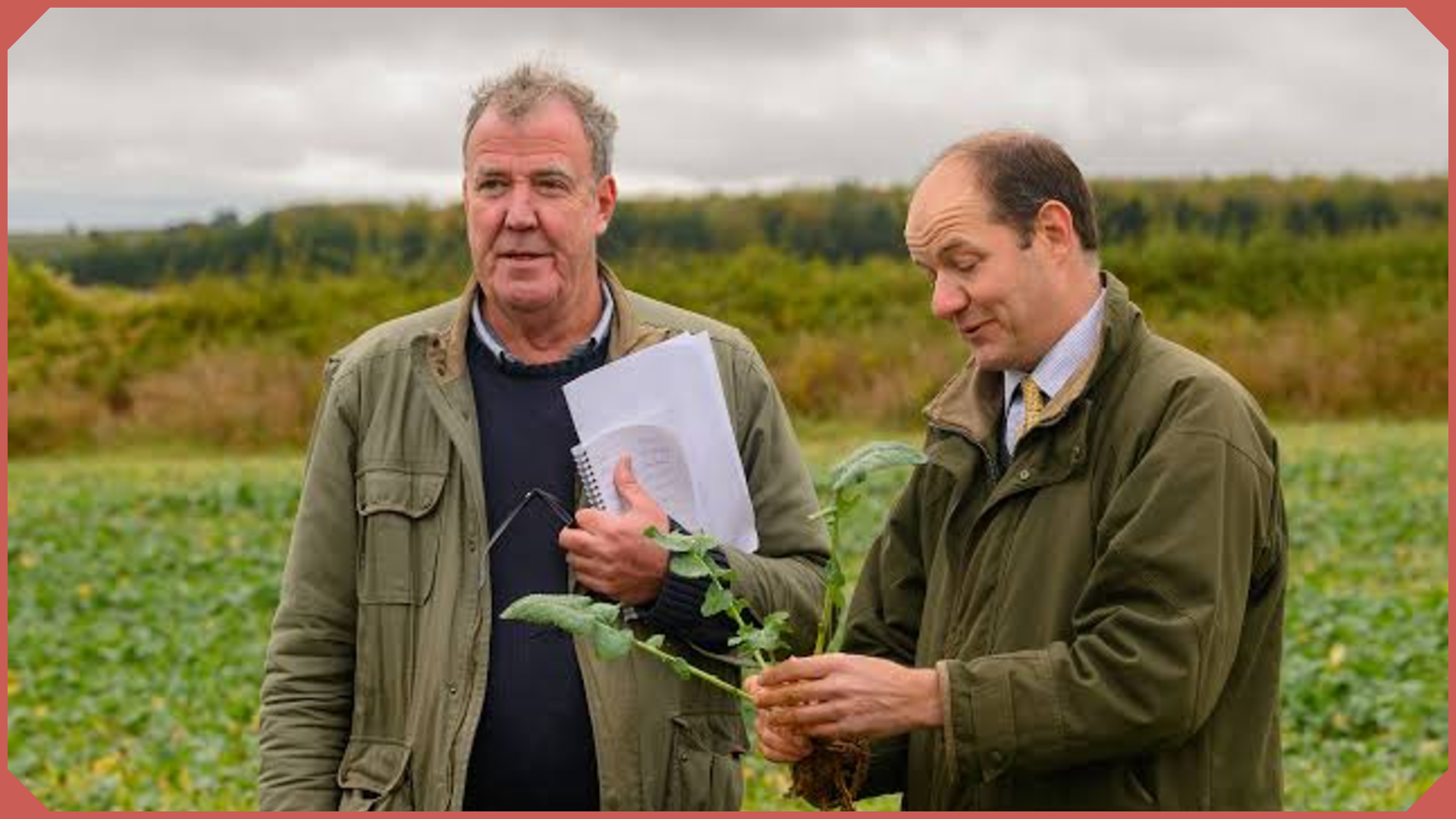
Clarkson’s Farm has become one of the most entertaining farming series on television, but its appeal goes beyond Jeremy Clarkson trying to understand tractors, crops and livestock. The series follows the everyday reality of running Diddly Squat Farm in the Cotswolds, combining farming, business decisions, weather problems, local planning disputes and the personalities of the people working there.
Since its debut in 2021, the series has developed from a simple story about a television presenter learning how to farm into a much broader look at modern agriculture and the difficulties of making a farm financially sustainable. As of 2026, there are five seasons, with eight episodes in each season, giving viewers 40 episodes to follow Clarkson’s farming journey. Prime Video lists Season 5 as the latest season, released in 2026.
What Is Clarkson’s Farm About?
The series follows Jeremy Clarkson as he takes responsibility for Diddly Squat Farm in the English countryside. Clarkson bought the farm in 2008, but his serious involvement in its agricultural operation became the central subject of the television series years later.
The first season introduced viewers to the reality of farming from the perspective of someone without years of professional farming experience. Clarkson quickly discovers that owning farmland and successfully operating a farm are very different things.
The show is built around real agricultural work, but it also gives considerable attention to the people involved. Kaleb Cooper became particularly important because of his practical farming knowledge and his often blunt reactions to Clarkson’s ideas. Lisa Hogan also became a familiar presence through her work around the farm and its businesses.
What makes the episodes interesting is that a relatively ordinary farming task can become a much bigger challenge. Weather can destroy plans, animals require constant attention, machinery can cause problems, and seemingly straightforward business ideas can run into complicated regulations.
Season 1
The first season introduced the basic story of Diddly Squat and Clarkson’s attempt to become a farmer. It began with “Tractoring,” in which Clarkson started his farming journey and faced the realities of operating agricultural machinery.
The following episode, “Sheeping,” introduced another major part of the farm’s development. Clarkson decided to keep sheep, only to discover that livestock bring responsibilities that cannot simply be ignored. Prime Video describes the episode as Clarkson discovering the complications associated with keeping a flock.
“Shopping” moved the story toward the farm’s commercial side as Clarkson tried to establish a farm shop for his own produce. The idea sounds simple, but the episode demonstrates how difficult it can be to turn agricultural products into a profitable business.
The remaining episodes, “Wilding,” “Pan(dem)icking,” “Melting,” “Fluffing” and “Harvesting,” continue the story through changing weather, farming experiments, livestock, machinery and the pressures of the harvest.
Season 1 is important because it establishes the formula that later seasons develop further. Clarkson makes ambitious plans, something inevitably goes wrong, and the people around him often have to help solve the resulting problem.
Season 2
Season 2 expanded the scope of the series. Clarkson was no longer simply learning the basics of farming. He was trying to make Diddly Squat more profitable and diversify its activities.
The season opened with “Surviving,” where Clarkson considered ways to increase the farm’s income after making only a very small profit previously. Prime Video notes that the previous year’s annual profit had been just £144, setting the stage for Clarkson’s attempts to find additional sources of revenue.
“Cowering” introduced a herd of cows and the practical problems that followed. The animals quickly demonstrated that keeping livestock is not simply a matter of buying them and putting them in a field.
Planning and local government became even more important in “Schmoozing.” Clarkson had to deal with the council and the rules surrounding his plans for the farm. “Badgering” brought another environmental challenge into the story, with Clarkson dealing with one of his farming nemeses: the badger.
The remaining episodes were “Council-ing,” “Counselling,” “Scheming” and “Climaxing.” Together, they showed how the farm was becoming a complicated combination of agriculture, retail, planning and business.
Season 2 also helped establish one of the central themes of the series: farming is affected by much more than what happens in a field. Government rules, planning decisions, environmental concerns and financial pressures can all influence whether a farm project succeeds.
Season 3
Season 3 took the series into a more difficult period for Diddly Squat. When viewers returned to the farm, the situation was already complicated. Prime Video describes the farm as being in turmoil, with the council having shut down the restaurant, poor weather making crop planting difficult and rising costs creating additional pressure.
The opening episode, “Unfarming,” therefore begins with Clarkson needing a new plan to get through the agricultural year.
“Porking” introduced pigs to the farm, giving Clarkson and his team another type of livestock to manage. The episode also continued the tension between Kaleb’s farming work and activities taking place around his fields.
The season continued with “Jobbing,” “Harrowing,” “Healing,” “Mushrooming,” “Parking” and “Calculating.”
By this point, the series had developed beyond a simple comedy about a celebrity learning to use a tractor. The episodes increasingly showed the economic realities of farming, the importance of planning and the difficulty of finding profitable uses for agricultural land.
Season 3 is also remembered for its more emotional moments. The relationship between the people at Diddly Squat had become an important part of the show, making setbacks feel more personal than they had in the first season.
Season 4
Season 4 arrived in 2025 and continued the expansion of Diddly Squat beyond traditional crop farming. Prime Video describes Clarkson as taking on an ambitious project involving the purchase of a pub, while new livestock, machinery and people add further activity to the farm.
The opening episode, “Solo-ing,” places Clarkson in an unusual position. With Kaleb and Lisa away, he has to manage the farm largely on his own. A new farmhand arrives to help, while Clarkson gets an opportunity to think about the farm’s future.
“Pubbing” then focuses on Clarkson’s search for a pub, reflecting his broader ambition to connect farming with food and hospitality. The idea fits with the farm-to-fork direction that has developed throughout the series.
The season continues with “Crawling,” “Cottaging,” “Endgaming,” “Splurging,” “Hurrying” and “Landlording.”
Season 4 is particularly interesting because the farm is no longer being treated as a single agricultural operation. Clarkson is trying to build a wider business around Diddly Squat, which brings new opportunities but also creates new responsibilities.
Season 5
Season 5 is the latest season of Clarkson’s Farm, released in 2026. Prime Video lists eight episodes for the season and describes a major push toward changes at Diddly Squat, including high-tech farming equipment and developments connected with what the show calls “Diddly Squat 2.0.”
The first episode, “Operating,” begins with Clarkson looking for ways to make life at the farm less stressful following a health scare. A new breed of sheep is part of the plan, while the pub creates its own complications.
“Storming” moves attention toward the pub’s first festive season. The Farmer’s Dog hosts a major musical event, while farmers across Britain gather to protest against the government’s latest tax measures.
In “Tripping,” Clarkson takes Kaleb abroad for the first time to explore high-tech approaches to farming. The episode reflects one of the season’s major themes: whether technology can make farming more efficient and less dependent on traditional methods.
“Updating” continues this technological direction as autonomous farming arrives at Diddly Squat. At the same time, problems continue at the pub and with the pigs.
The final four episodes are “Decapitating,” “Frazzling,” “Sickening” and “Reaping.” The season eventually reaches harvest time while the farm is dealing with the consequences of a tuberculosis diagnosis. Prime Video describes the finale as a particularly difficult harvest, with the Diddly Squat team waiting for results before assessing the farming year.
The Main Characters
Jeremy Clarkson is naturally at the centre of the show, but the series would look very different without the people around him.
Kaleb Cooper has become one of the most recognizable figures associated with the programme. Unlike Clarkson, Kaleb has genuine practical farming experience and is frequently the person who understands what needs to be done. His reactions to Clarkson’s decisions are an important part of the show’s humor.
Lisa Hogan has also played an important role, particularly as Diddly Squat has developed its commercial activities. Her involvement adds another perspective to the farm’s business side.
Gerald Cooper is another familiar face around Diddly Squat. His presence, personality and knowledge of the countryside have helped make the farm feel like a real working environment rather than simply a television set.
The strength of the cast comes from the contrast between their personalities. Clarkson often approaches farming as a businessman and enthusiastic amateur, while the experienced people around him understand that agriculture does not always respond well to ambitious plans.
How the Series Has Changed
The progression from Season 1 to Season 5 is one of the most interesting aspects of Clarkson’s Farm.
The first season is largely about learning. Clarkson has to understand tractors, crops, livestock and the basic rhythm of agricultural life.
The second season expands the financial question. The farm needs to make money, so Clarkson begins looking at diversification and new businesses.
By Season 3, planning restrictions, rising costs and difficult farming conditions become central to the story. The series becomes more serious about the challenges facing farmers while retaining its humor.
Season 4 pushes the business further into hospitality with the pub project. By Season 5, technology and automation have become increasingly important, showing how the farm continues to evolve.
This progression gives the programme a sense of continuity. Each season does not simply repeat the same jokes. Instead, the decisions made earlier create new problems and opportunities later.
Why the Episodes Remain Popular
One reason people continue watching is that the show feels unpredictable. Farming itself provides plenty of uncertainty, but Clarkson’s personality adds another layer.
The programme also balances comedy with genuine agricultural issues. Weather, crop yields, livestock, machinery costs, planning rules and taxation are not merely background subjects. They affect the farm’s ability to survive.
Another strength is the relationship between Clarkson and Kaleb. Their disagreements are entertaining, but they also highlight the difference between theoretical ideas and practical farming experience.
The series has also gradually become more emotional. Farming involves financial risk, animal welfare and personal attachment to the land. As the seasons progress, viewers see that success at Diddly Squat cannot be measured simply by whether Clarkson manages to complete a particular project.
Best Way to Watch the Episodes
For a first-time viewer, watching the episodes in release order is the best approach. The story develops continuously, and projects introduced in one season often influence events in later seasons.
Starting with Season 1 also makes the changes at Diddly Squat easier to understand. Viewers can see how Clarkson moves from basic farming experiments toward a much larger operation involving livestock, retail, hospitality and modern agricultural technology.
Those who have already watched the earlier seasons may want to start Season 5 by revisiting the later episodes of Season 4, particularly because the pub and wider business developments continue into the newest season.
Where to Watch
Clarkson’s Farm is available through Prime Video, where the current listing shows five seasons. Each season contains eight episodes.
The official episode listings are useful for checking individual episode names, release dates and running times. They also provide short descriptions of the storylines without requiring viewers to rely on unofficial episode lists.
Frequently Asked Questions
How many Clarkson’s Farm episodes are there?
There are currently 40 episodes across five seasons, with eight episodes in each season. Prime Video’s current listing confirms five seasons and eight episodes for Season 5.
What is the first Clarkson’s Farm episode?
The series begins with “Tractoring,” which introduces Jeremy Clarkson’s attempt to run Diddly Squat Farm and learn the realities of farming.
Who is Kaleb Cooper?
Kaleb Cooper is a farmer who works with Clarkson at Diddly Squat. His practical knowledge and straightforward personality have made him one of the most popular people in the series.
What is the latest season of Clarkson’s Farm?
Season 5 is currently the latest season. It was released in 2026 and focuses on new farming technology, business developments and another difficult year at Diddly Squat.
Where can I watch Clarkson’s Farm episodes?
The series is available on Prime Video. The platform currently lists Seasons 1 through 5 and their individual episodes.
Conclusion
Clarkson’s Farm episodes offer much more than a collection of funny moments involving tractors, sheep and Jeremy Clarkson’s farming experiments. Across five seasons, the programme has followed the gradual transformation of Diddly Squat from a relatively straightforward farm into a complicated business involving agriculture, livestock, retail, hospitality and technology.
The early episodes focus heavily on Clarkson learning how farming works. Later seasons explore profitability, planning restrictions, new businesses and the changing nature of modern agriculture. At the same time, the relationships between Clarkson, Kaleb, Lisa and the rest of the team give the series its personality.
With 40 episodes currently available across five seasons, there is plenty of material for both new viewers and long-time fans. The continuing story of Diddly Squat works because it combines real agricultural problems with humor, human relationships and the unpredictability of trying to make a living from the land.
